It is the most compact and simplified real two-chamber wood stove, having a footprint of just 0.18 sq.m. on your floor. I’ve published a extensive post about stove designs in this blog. People interested in the so-called „rocket stoves“ are familiar with the secondary burning chamber named „heat riser“. Note: Google tells me that I should name it combustion chamber since there are no flames in the heat riser. But on this page I reveal the „secret“ of my version for primary combustion chamber with gravity fed log hopper, which I claim to be substantial improvement in the rocket stove family.
The base of the burner is only 15x15cm and this is the whole space where the kindlings first and then logs are nested vertically. Actually these are two 2L juce carton boxes next to each other. Burning takes place in 15x15x15cm volume or 3.4 liters! Just to compare at home my 2012 stove Prity has a chamber with dimensions 30х37х30сm or 33,3 liters, which is tenfold bigger. Well normally the fuel in such chamber can’t be more than half and I tend to put only few small logs at a time but still the difference is huge.
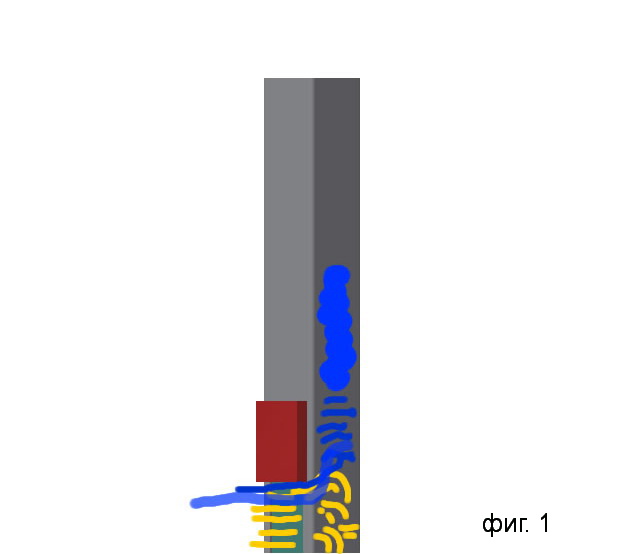
At fig.1 you can see scheme of the chamber and hopper actually they represent common space. In it the logs are stacked vertically in three layers. I skipped them to simplify the picture. At the bottom of chamber you can see located the outlet (in green) that can be fully or partially covered by the sluice-like main valve (in red). The valve can be lifted or lowered in order to manage the burning process. When valve is fully opened the flames (yellow lines) embrace the logs up and a little bit over the upper edge of the outlet. The blue lines mark the fumes/smoke that has been emitted from the wood logs. which consists of steam and flamable gases. The hopper part is sealed from the top so steam-fumes mix can’t find a way to the chimney. They are emitted continuously in the first stages of burning. The space between the logs is fully occupied by steam-fumes mix and its lower part contacts the flames before both being sucked out through the outlet in the heat riser. In this set up the chamber works as typical rocket mass heating device. Well I added secondary air inlet but for now this is not part of the presentation. The Chimneything zero version (or prototype) which I run at home got bigger inlets so I could make observations in the RnD process, but the final version has smaller and horizontally oriented valves securing the risk of spontaneous dropping. It turned out that stove works with very low airflow so inlets had to be only half of the test size. This is quite noticeable when it concerns secondary air (left valve on the drawer face, but also for the primary air (right side of the drawer).
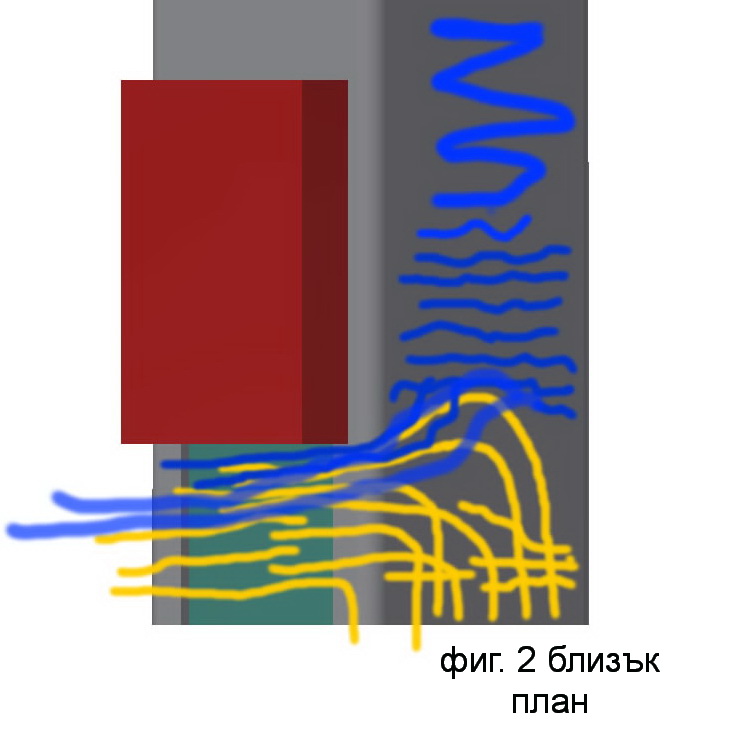
If we lower down the main valve to the middle as shown on fig. 2 the suction of the flames also goes down and at the same time flames are being „pressed down“ by the steam-fumes mix which also lowers its level. This way parts of the logs are taken out from the active burning process. The steam-fumes zone lack oxigen so there the logs are transformed to charcoal more actively. Thus instead of braking down as normal during burning the logs smoulder glowing with nice red light. The fumes coming from above rapidly consume oxigen so carbonized wood doesn’t immediately burn out and keeps supporting the upper logs. Even the thin kindlings that I’ve put on the base row burn for an hour or so before braking down and letting the upper ones to get in the active burning zone.
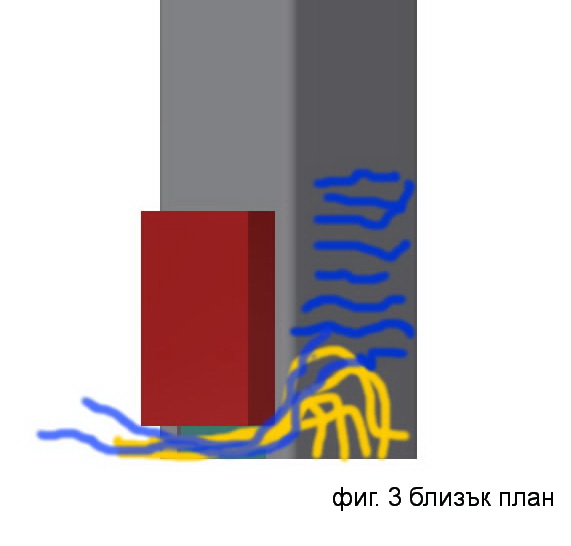
If we lowered the mail valve further down the situation changes a lot (fig. 3 close look). This is because now the flames and the fumes should pass a narrow outlet. It is obvious that there is no way for all components to pass without mixing each other. At the same time another part from the logs is excluded from active burning respectively charcoal forming continues while the ambient temperature is still high. If we continue lowering the main valve the upper gases and the small outlet reduce active burning process too much so there is not enough heat to maintain the pyrolysis decomposition of the upper logs. Depending on the temperatures outside the draw may be strong enough to keep the working like this but if it is not cold the stove may stop working.

The last view is from the back of the chamber where I’ve provided for a narrow air inlet. This is used only for starting or for burning fat logs (or not fully dry). You can see that we show main valve lowered situation (the red detail to the left).
While drafting this page I’ve prepared several clips with improved quality. These are located here with additional information on the subject. There you can watch all processes described above as real time action. In one of the clips you can watch the ability of Chimneything for smooth 12 hour long burning without refuel. In the other I show that this stove is capable of reaching serious temperatures above 350оС so no problems with cold room heat up. Well there are stages of more intensive burning followed by less intensive depending on how strong charcoal structures have been formed preventing new fuel to come down to the active burning zone. In the last month me and my friend experimented with eco briquettes from compressed sunflower peals. These turned out to be very useful. All recordings have been made with these. Their big density allowed me to put more mass in the hopper keeping the same volume while sunflower oil residues in the briquettes makes them a little bit more energy dense on top of the mass. After oil is gone the ember formed provides long lasting heat. The fluffy ashes however may turn out to be a problem if consumer needs more heat.
The difference between Chimneything stove and pyrolysis boiler is in its simplicity as there is no separate space for timber decomposition. It lacks complicated pipe connections. Nevertheless Chimneything utilize the wood fuel step by step resembling this way pellet stoves not trying to restrict the intake air as a means to manage strong burning. It is just that wood is not processed/milled to be rationed like it is done with pellets. It is just a clever use of chemical and physical properties of the timber.
Enjoy watching!
 Коминче - място за една добра печка